Farnham Beekeepers

  • Home
  • About
  • Beecraft
  • Schools
  • Links
 

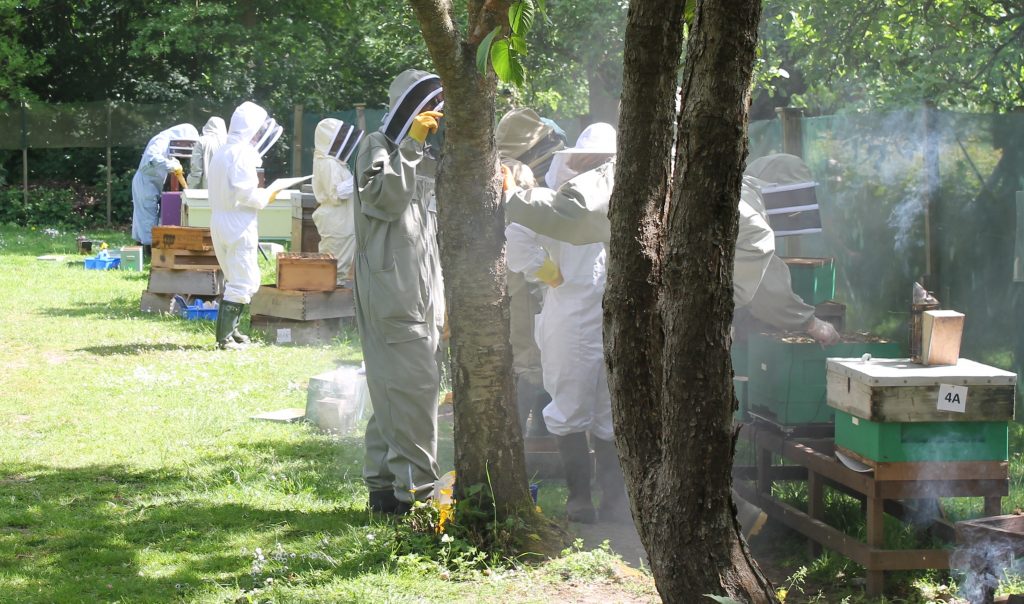
Our Apiary is based at the 
Rural Life Centre in Tilford, Surrey. From April to September we meet weekly.

Swarms – Don't Panic!!!

Please read "How to Recognise a Swarm" first, if you think you have one, call one of the contacts below. They will want to know:
1) Where you are 2) Where the swarm is 3) What it has settled on (tree, ground, fence, etc) 4) How high off the ground 5) When you are at home 6) Is there good access
The FBKA collectors are:
Mrs Anne Buckingham 01252 714069
Mr Mike Dorricott 0780 385 1070


Equipment for Sale
Click to view Listings
  

DIARY

Last Saturday of the month
Extended meeting - tea afterwards
.........................
Sunday 12th September, 
Farnham Division Honey show
Rural Life Centre
.........................
October 28th - 30th, 
National Honey Show
Woking
.........................


Members Area

COMING SOON!!
 

Welcome to Farnham Beekeepers
A Division of the Surrey Beekeepers' Association 

In the Apiary - August

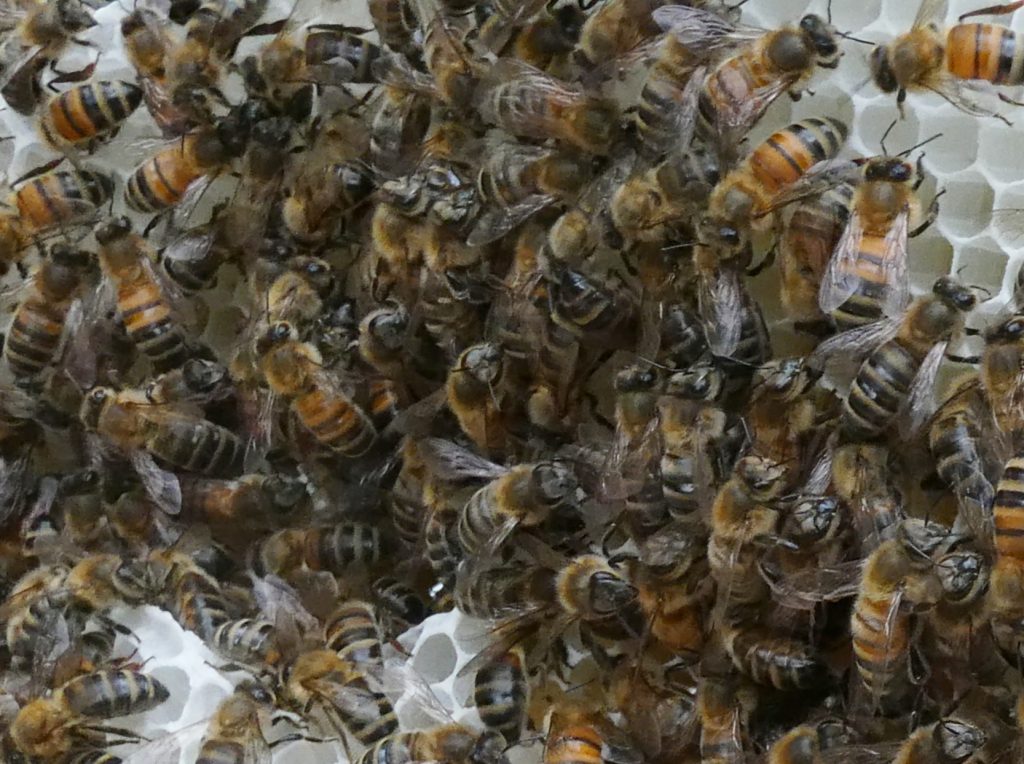
August is a month when the bees are short of forage, very little about now and there will be no nectar in the heather, so we tend to leave the brood boxes alone.  Robbing is a main concern, so many of you will have received emails saying close those entrances  -  if you see any signs of robbing close down to just a couple of bees width.  A weak colony, or nuc, is very vulnerable.  

Another very real problem is wasps, and these, once they get into a weak colony, can devastate it.  Other bees will also rob out a weak colony, and once bees start robbing it is difficult to stop them, they become mindless and remarkably bad tempered as they all, quite literally, fight over the food.  If you need to go into your bees, every box needs to be covered - and be quick, don't waste time.  Wasp traps either on the hive or hung in trees are a good idea, jam/water in a jar, covered in newspaper with a hole in the middle works as well as anything.

Those of you who have no supers on, now is the time to apply Apiguard, straight onto the brood with an eke to give them just enough space.  Don't think because you have a nuc with only a few frames they don't need some form of treatment for Varroa -  they all will, but read the instructions first, and remember to put the inserts under the hive, to close in as much of the vapour as possible.  Apiguard can be bought from Wynne-Jones (see Beecraft) or Beechwood Bees (Web address is: http://www.beechwoodbees.co.uk ) both about £22 postage paid.  If anyone has any Apiguard over, why not bring it to the apiary to sell on?I know that the instructions say don't feed while applying Apiguard, but you must use common sense on this.  

Have your bees plenty of stores?  No food is coming in now and you must feed if they are short ie, if they haven't some completely full brood frames of food  - the larger the colony, the more frames should be full.By the time a full sized colony is settled for the winter (September) they will need 20kg of stores  -  that is a full brood box and more on top  -  by that time mine have a double brood box, both virtually full (every frame that does not have brood in it!).  We used to say a full brood box and a full super on top  -  now we say two brood boxes.  

Mid to late August is the start of next season, so you do need to get your bees into good order, ready for next year!  Bees will be reluctant to draw frames now, but if you have a small colony and are hoping they will build up, continuously feed a weak syrup (1 kg sugar to 1 litre water) to encourage them to draw out frames but if you have a large colony and you want them to store the syrup, a strong solution (1/2 litre to 1 kg), but, remembering last year, leave some room for the queen to continue laying.

Maltings Farnham Grows

Report from Margaret Lennard

Many thanks to all our volunteers who contributed to the FBKA stand at the Maltings' Festival of Gardening last Saturday. The public seemed to enjoy our mix of information on bees and their effect on the food we eat, live bees, honey tasting, candle rolling, and sales of hive products.  
We were busy but not rushed for most of the time, and the general feedback from members was thatthey enjoyed the day and would be happy to volunteer again. The Town Mayor spent some time chatting, there was a lot of interest in our information and our sales table did very well.
Our space in the Maltings was very generous and we were able to fill the area without being overcrowded. Below are some pictures of the day:

IMG_2356.jpg

IMG_2354.jpg

IMG_2353_2.jpg

IMG_2351_2.jpg

IMG_2352_2.jpg

Granulated or naturally set honey 

The following has kindly been contributed by Mary Hill, one of the BBKA Honey Judges:

The first thing to do is to understand how granulated honey is different from soft set honey. Granulated honey is honey which has been extracted and after filtering is put straight into jars. It is NOT stored in tubs, melted and put into jars or mixed with other honeys before jarring.

The decision to produce good granulated honey must be made before extraction starts.Having made this decision make sure you extract the honey on a warm day straight from the hive. If you have to store it keep the supers in a warm place. Honey which has some rape nectar in it gives a finer grained honey. 

After extraction the honey must be filtered through the finest filter you can find. Very fine nylon or a polyester fabric. I use a Strainaway with 100x100 filter. These are not made any more but you might get one secondhand. For smaller amounts Lakeland Strainer Jug is very good, but again this is out of production.

Store the honey in a settling tank overnight. Estimate how much honey you have and decide that the first third is going to be your very good honey. Wash the jars in hot water and let them drain dry. If you use a drying cloth make sure it is not fluffy.

Fill the jars so that there is no gap between the top of the honey and the bottom of the lid. Store the jars on a LEVEL shelf.

After three days remove any scum that has risen to the surface by placing a piece of clingfilm on the surface to pull off the scum. Put the jars back on the shelf and wait for the honey to set. You don't need to do anything else. The quicker it sets the finer the granulation will be.

When it has set do not worry about any frosting that occurs, this is a natural process. In a show the only penalty would be if someone had honey as good as yours but without frosting.

Before entering in show carefully check all over the jar for "foreign bodies", most of them will be on the bottom.  Granulated honey that is clean ie no black dots will win a prize because not many people plan ahead.  Make sure that the lid is clean inside.

Honey bees linked with cure to fight hospital superbug

This was the headline of a short newspaper article (Daily Telegraph, June 17). The article was based on a paper published in January in the journal Phytotherapy(??) Research. A crude extract of propolis was tested on MRSA isolates and the results 'revealed activity worthy of further investigation'. Subsequent purification of the propolis led to the identification of prenylflavanones, named propolins; propolin D and propolin C were found to have anti-MRSA activity.

Original newspaper article contributed by Georje Reed


 - - - - - - - - - - - - - - - - - - - - - - - - - - - - - - - - - - - - - - - - - - - - - - - - - - - 

rlc2009.gif

 
Built with concrete5 CMS. © 2010 Farnham Beekeepers.    All rights reserved. Sign In to Edit this Site